William Beeson
Online Nickname: Sky King
Introduction
I am William Beeson, dubbed the Sky King by my friends for my vertically-prominent stature. I’ve read countless TTRPG books, books on game design, and even written a few games/adventures myself. As my group’s Forever GM for the better part of 20 years I’ve developed a deep appreciation for all games and always manage to find something endearing in every work.
Professionally I’m an accountant and Enrolled Agent, which is a round-about way of saying I enjoy numeric/rules-oriented systems. When addressing a new game, I fervently dive into the mechanics to ensure objectively there is no blatant disparity between what the author intended and how the rules-as-written function.
Why do you play/run RPGs?
For the love of the game, why else? What’s more fun than gathering friends around a table and collaboratively telling stories of high-adventure, drama, unfathomable stakes, the human experience and letting math rocks decide the course of events. There are so many fascinating and wild RPGs out there, that in order to experience as many as possible I’ve taken the honorary role of Forever GM.
My first exposure to tabletops was the Dexter’s Laboratory episode D&DD. I was enamored with the idea of a game where anyone could just use their imagination to make things happen. From there, I got my first Dungeons & Dragons set that was definitely not appropriate for a child my age; and the rest is history.
The ENNIES requires a major commitment of time and energy. What resources do you have that will help you discharge these responsibilities? Will your gaming group or other individuals be assisting you? Does your family support you?
As a former ENNIEs judge and am well-versed in the time commitment and expectations of the position. If the prior year’s notebook is any indication, I take thorough and extensive notes of each product that comes through, making sure that everything gets the recognition it deserves.
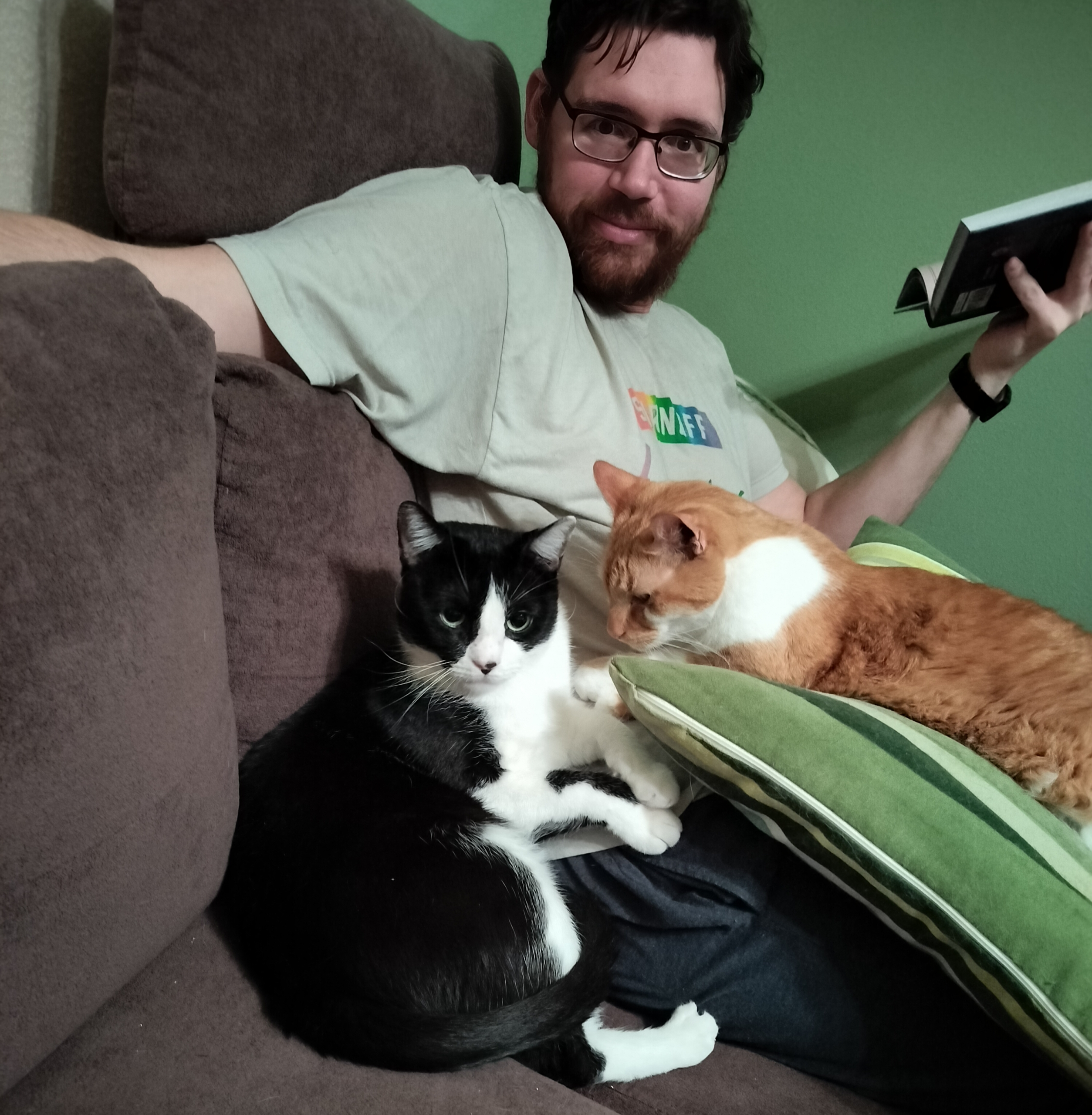
With regards to support, I have an incredibly supportive network of friends and colleagues. From the rotating throng of players at my table to the local Adventure’s Guild, of which I’m an officer, I can rely on any and all of them to assist. Further, I have the most encouraging partner I could ask for, willing to sit with me in the living room doing legos while I read, or grabbing books and joining in. Beyond that I have three cats who excel at sitting on my lap and locking me in place, thus forcing me to continue reading.
My family? They may not understand the hobby, but they’ll support me through it all. You da man, Uncle Phil.
Judging requires a great deal of critical thinking skills, communication with other judges, deadline management, organization, and storage space for the product received. What interests, experience, and skills do you bring that will make you a more effective judge?
I’d consider myself to be an articulate individual, where explaining complex concepts in understandable terms is a common part of my day-to-day. As previously mentioned I’m an accountant by trade so deep analysis, deadlines, and group coordination are all part of my skillset. Prior to being an accountant, I worked in the service industry, retail, and hospitality. Suffice to say I’m familiar with the human-experience that a substantial amount of modern games touch upon.
As far as storage is concerned, I’ve got an entire hobby room at my disposal with recently-emptied bookshelves.
What styles and genres of RPGs do you enjoy most? Are there any styles or genres that you do not enjoy? Which games best exemplify what you like? Do you consider yourself a fan of a particular system, publisher, or genre?
The super-hero genre is one of my favorites; this extends to any games in a more modern setting where the PCs have superhuman abilities (a la Triangle Agency). Some of my favorite games that exemplify what I like about the genre are the Sentinels Comics RPG for its open interpretation of character powers while still having mechanical “crunch” and Spectaculars for its world-building guide that perfectly maps to the tropes of the genre.
I would be hard pressed to find a game-genre or style that I didn’t enjoy. As a B-movie aficionado I tend to appreciate even what is universally panned. A game designer would have to be actively trying to make the most reprehensible vile product for me to be averse to it.
Favorite Publishers include: Free League, Rowan Rook and Decard, Mythworks, anything by Tom Bloom.
Systems: Again, I love everything from the gritty, tactical combat of LANCER to the fly-by-the-seat-of-your-pants engagements of Outgunned, all the way to the familial drama of Slugblaster!
List (up to 5) games you’ve played in the last 2 years. What drew you to playing them? Which did you like best and why?
Mothership: A good friend wanted to run a one-shot and I’ve always wanted to try and survive a meat-grinder intact. Long-story-short, I was converted into a bubbling puddle that was washed down the drain.
Pirate Borg: I was initially drawn in by the art, but after talking with the author I was sold on trying out the system and I’m very glad I did. Of all the Borgs I’ve read and played in this one was my favorite between the theming, history-inspired setting twisted with the supernatural, and flavorful character options I immediately purchased a copy and look forward to running it in the near future as a long-form home game.
CAIN: Jujutsu Kaisen was all the rage and Tom Bloom makes great games! I loved the paranormal detective play of finding out what tragedy spawned the horrifying monster before engaging it in an over-the-top anime-esque battle.
Have you been a game master in the past 2 years? If yes, what games have you run? What made you decide to run those games?
I typically am the gamemaster at tables. A sampler of games I’ve run in the past are:
Dragonbane: I’ve used this game to introduce new people to the hobby countless times. Its rules-liter than the current biggest name in the industry, but with all of the trappings people come to expect. Combat flows well, the monsters are enjoyable to run as a DM and be attacked by as a player. And, of course, you can play as a duck.
Triangle Agency: I enjoy the SCP Foundation and after a stint with Delta Green, the Triangle Agency felt like the “fun side” of cosmic horror. This was a great choice for our next long-form home game as the system has a built in focus on the player character’s personal story progression through “playwalled” content.
Sentinels Comics the RPG: This game does a great job of simulating comic book narratives in which the heroes are able to further the business of the plot while simultaneously punching megalomaniacal madmen and their minions.
Summarize the criteria you would use to determine if a game deserves to be nominated for Best Game.
This would have to be a complete package all-in-one book. It needs to contain engaging rules of play, character creation that makes both players and GMs excited for the story surrounding sed PC, and an adventure (or means of building one) that provides plenty of opportunity for decision making and player agency. The Best Game contains evocative descriptions of the scenarios players at the table could engage with and stunning art to match. Legibility, the ability to parse information from visually interesting layouts is also a must.
How will you judge supplements or adventures for game systems whose core rules you are unfamiliar with or you believe are badly designed?
System agnostic metrics for a good adventure are, having an interesting premise and varying avenues for the PCs to approach the goal from, engaging NPCs that can move the plot forward or become a hindrance if engaged with, opportunities for different character skillsets to take the spotlight. A truly outstanding adventure with the aforementioned traits will conjure the desire to convert it to a system I’d prefer to run OR, entice me to purchase the system it is designed for.
How would you like to see the ENNIEs change? What should remain inviolate?
Personally, I think the “Best Streaming” category should be done away with. In this era of hours long actual plays that are more akin to radio theatre it doesn’t do any of the entrants justice to judge them on less than a full season/episode/etc. Which, given the time constraints of the judging period, is impossible.
Additionally, I think five is the correct number of judges, anything less could lead to a lack of diverse opinions when discussing entrants.